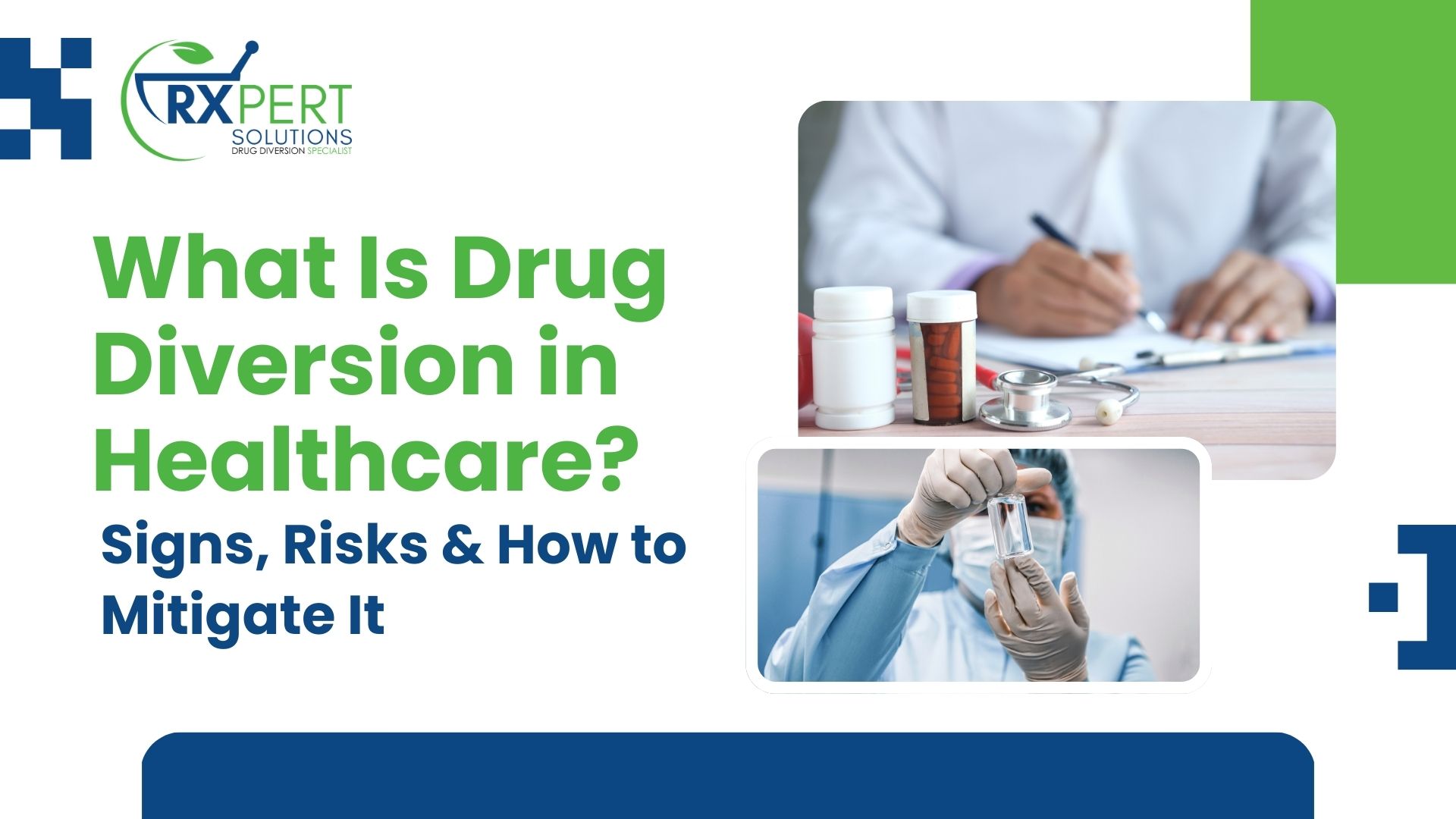
Drug diversion in healthcare is one of the most serious and costly risks facing hospitals, surgery centers, and clinics today. If you’re asking what is drug diversion in healthcare, you’re already ahead of most organizations — because early awareness is the first step in mitigation.
Drug diversion in healthcare occurs when controlled substances are redirected from legitimate medical use to unauthorized use, theft, or illegal distribution. While many assume diversion is rare, federal investigations show it is a persistent and growing threat inside healthcare systems.
Left undetected, diversion can lead to patient harm, DEA enforcement, CMS sanctions, lawsuits, reputational damage, and even criminal prosecution.
→ Request a Free 30-Minute Risk Assessment
Confidential. No obligation. Executive-level clarity on your current exposure.
What Is Drug Diversion in Healthcare?
At its core, drug diversion in healthcare refers to the unauthorized redirection of prescription medications—most commonly controlled substances—from their intended medical purpose.
This often involves:
- Opioids (fentanyl, morphine, hydromorphone)
- Benzodiazepines
- Propofol
- Stimulants
- Injectable narcotics
Diversion typically happens internally. Healthcare workers have legitimate access, system knowledge, and authority — which makes diversion difficult to detect without structured monitoring.
According to the DEA Diversion Control Division, healthcare registrants are legally responsible for maintaining effective controls against diversion and ensuring proper handling of controlled substances.
Diversion methods may include:
- Removing medications from automated dispensing cabinets (ADCs)
- Falsifying waste documentation
- Substituting saline for opioids
- Exploiting override functions
- Manipulating inventory reconciliation processes
This is not just theft — it is a patient safety crisis waiting to happen.
Why Drug Diversion in Healthcare Is a Growing Risk
Understanding what drug diversion in healthcare truly means requires recognizing the broader risk environment.
1. The Opioid Crisis Impact
The U.S. Department of Health & Human Services (HHS) continues to identify opioid misuse as a national emergency, increasing scrutiny of prescribing and controlled substance management.
Healthcare institutions are under heightened regulatory pressure to demonstrate active monitoring and mitigation systems.
2. Patient Safety Threats
The CDC has documented outbreaks of bloodborne infections directly linked to tampered injectable medications diverted by healthcare workers.
When medications are replaced, diluted, or contaminated:
- Patients receive inadequate pain control
- Infection risks increase
- Litigation exposure escalates
3. Regulatory & Financial Consequences
Organizations may face:
- DEA fines and registration suspension
- CMS Conditions of Participation violations
- State board investigations
- Civil lawsuits
- Criminal prosecution
Hospitals have paid millions in penalties for inadequate diversion controls.
What Are the Most Common Signs of Drug Diversion in Hospitals and Clinics?
Recognizing early warning signs is critical to detecting drug diversion in healthcare settings before it escalates.
Behavioral Red Flags
- Volunteering for extra shifts involving narcotics
- Insisting on administering controlled substances
- Frequent reports of medication waste
- Avoiding peer oversight
- Defensive behavior during audits
Documentation Irregularities
- Excessive ADC overrides
- Delayed charting of medication administration
- Inconsistent pain scores
- Repeated transaction cancellations
- Incorrect witness documentation
Automated Dispensing Cabinet (ADC) Anomalies
- High discrepancy rates
- Removal patterns near shift changes
- Repeated waste adjustments
- Override frequency above peer averages
Patient Indicators
- Reports of uncontrolled pain
- Medications not producing expected effects
- Sedation inconsistencies
Without analytics-driven oversight, these signals are often missed.
→ Learn how Rxpert’s Drug Diversion Monitoring Solutions provide enterprise-wide visibility across units.
Detecting Drug Diversion in Healthcare Settings
Detecting drug diversion in healthcare settings requires moving beyond manual audits and spreadsheet reviews.
High-performing organizations implement:
1. Advanced Data Analytics
- Peer group comparison models
- Outlier detection
- Usage trend analysis
- Risk scoring by employee
2. Cross-System Integration
Monitoring should combine:
- ADC transaction logs
- EMR medication administration data
- Inventory reconciliation
- Waste documentation
- HR and shift data
3. Real-Time Alerting
The longer diversion continues, the greater the patient harm and legal exposure.
Early detection reduces regulatory risk dramatically.
→ Get a Drug Diversion Vulnerability Assessment Quote
We’ll evaluate your monitoring maturity and identify critical gaps.
How Can a Hospital Create an Effective Drug Diversion Mitigation and Detection Program?
A strong diversion mitigation program requires structure, governance, and accountability.
Step 1: Establish a Diversion Oversight Committee
Include:
- Pharmacy leadership
- Nursing leadership
- Compliance
- HR
- Security
- Legal
Step 2: Develop Clear Policies
Policies should address:
- Chain of custody controls
- Witnessed wasting procedures
- Incident response protocols
- Reporting requirements
- Investigation standards
Step 3: Implement Enterprise Monitoring
Diversion rarely stays in one department. Monitoring must cover:
- Operating Rooms
- ICUs
- Emergency Departments
- Oncology
- Behavioral Health
- Outpatient Clinics
Step 4: Train Staff Regularly
Education reduces stigma and encourages reporting. Many diversion cases are first identified by coworkers.
Step 5: Conduct Annual Risk Assessments
This is where many hospitals fail.
Diversion controls degrade over time without structured reassessment.
→ Rxpert Solutions specializes in comprehensive Drug Diversion Risk Assessments aligned with DEA and CMS expectations.
Drug Diversion in the Healthcare Setting Assessment: A Step-by-Step Framework
While the previous section outlines how to build a diversion mitigation program, this framework focuses specifically on how to formally assess, validate, and strengthen that program across the enterprise.
A formal drug diversion in the healthcare setting assessment should follow a structured, defensible risk-management framework. While regulators such as the DEA and CMS do not prescribe an exact checklist, they require healthcare organizations to demonstrate effective controls, active monitoring, and timely response systems.
The following step-by-step process reflects best practices used by mature healthcare systems to identify and close diversion vulnerabilities.
Step 0: Governance & Oversight Validation
Before mapping risk, leadership accountability must be defined.
An effective diversion program includes:
- An executive sponsor
- A multidisciplinary diversion oversight committee
- Clearly defined roles and responsibilities
- Documented meeting cadence
- Board-level visibility or reporting structure
If governance is unclear, response failures and documentation gaps are likely during regulatory review.
Step 1: Enterprise Risk Mapping
The organization must identify every controlled substance touchpoint from procurement through final disposal.
This includes:
- Purchasing and receiving
- Vault storage
- Automated dispensing cabinets (ADCs)
- Medication transport
- Administration workflows
- Waste handling
- Reverse distribution
- Destruction documentation
Diversion frequently occurs in workflow handoffs — not just at dispensing.
Step 2: Workflow Analysis
Mapping processes is not enough. Workflows must be stress-tested in real operational conditions.
A structured review evaluates:
- Ordering practices
- Receiving controls
- Storage security
- Dispensing configuration
- Administration documentation
- Waste verification integrity
- Return procedures
- Destruction chain-of-custody
This step often reveals informal workarounds that create risk exposure.
Step 3: Control Effectiveness & Analytics Maturity
Having policies does not mean they are working.
This step evaluates:
- ADC override restrictions
- Witness documentation integrity
- Inventory reconciliation frequency
- Peer comparison analytics
- Outlier detection capability
- Audit procedures
- Investigation timelines
Organizations should assess whether monitoring is proactive or reactive.
If suspected diversion has not been proactively identified in the past year, monitoring effectiveness should be examined closely.
Step 4: Cultural & Reporting Environment Assessment
Many diversion cases are first identified by coworkers.
A comprehensive assessment examines:
- Anonymous reporting mechanisms
- Non-retaliation protections
- Staff diversion awareness training
- Annual education requirements
- Psychological safety culture
A strong reporting culture dramatically reduces time-to-detection.
Step 5: Incident Response & Investigation Readiness
When diversion is suspected, the response must be structured, timely, and defensible.
This step evaluates:
- Investigation protocols
- Interview procedures
- Documentation standards
- DEA Form 106 reporting workflow
- HR and legal coordination
- Evidence preservation practices
- Root cause analysis framework
The most dangerous period for an impaired staff member is during confrontation and removal. Structured preparation reduces organizational and personal risk.
Step 6: Gap Analysis Against Regulatory Expectations
Current controls should be evaluated against:
- DEA requirements for “effective controls”
- CMS Conditions of Participation
- Accreditation standards
- Industry best practices
The goal is not perfection — but defensibility.
Step 7: Remediation Roadmap & Prioritization
Identified gaps should be prioritized based on:
- Patient safety impact
- Regulatory exposure
- Financial risk
- Likelihood of occurrence
High-risk units such as Operating Rooms, ICU, Emergency Departments, Oncology, and Behavioral Health often require accelerated corrective action.
A formal remediation roadmap demonstrates organizational commitment to compliance.
Step 8: Ongoing Monitoring & Continuous Improvement
Diversion mtigation is not a one-time compliance exercise.
Sustainable programs include:
- Continuous monitoring
- Routine committee review
- Annual enterprise reassessment
- Corrective action tracking
- Executive reporting
Organizations that implement structured annual assessments significantly reduce regulatory and financial exposure.
Enterprise Visibility Is the Differentiator
Enterprise visibility separates reactive programs from defensible systems. Diversion rarely remains isolated within one unit. Without cross-department oversight, patterns go undetected.
If your organization has not completed a formal enterprise-wide diversion assessment within the past 12 months, it may be time to evaluate your current risk exposure.
→ Request a Confidential 30-Minute Drug Diversion Risk Assessment
We’ll help you identify blind spots and outline next steps — no obligation.
Regulatory & Legal Implications of Drug Diversion in Healthcare
A structured assessment framework is not just operational best practice — it is regulatory risk protection. When diversion occurs, investigators will evaluate not whether a policy existed, but whether the organization actively monitored, detected, responded, and corrected systemic weaknesses.
Regulators expect proactive monitoring — not reactive discovery.
Failure to detect drug diversion in healthcare may result in:
- DEA enforcement actions
- Controlled substance registration suspension
- CMS sanctions
- Civil liability for patient harm
- Criminal prosecution
Healthcare leaders are personally accountable for oversight failures.
This is no longer optional compliance — it is enterprise risk management.
Frequently Asked Questions
Protect Your Organization Before Diversion Becomes a Crisis
Drug diversion in healthcare is not just a pharmacy issue — it is a patient safety, compliance, and executive leadership issue.
Organizations that wait until diversion is discovered face:
- Regulatory investigations
- Media scrutiny
- Patient harm
- Lawsuits
- Financial loss
Organizations that wait for confirmed diversion are already in damage-control mode. Proactive assessment and continuous monitoring are the only defensible strategies.
→ Request a Free 30-Minute Risk Assessment
Executive-level review. Clear next steps. Completely confidential.
→ Or explore our full suite of Drug Diversion Mitigation & Monitoring Solutions