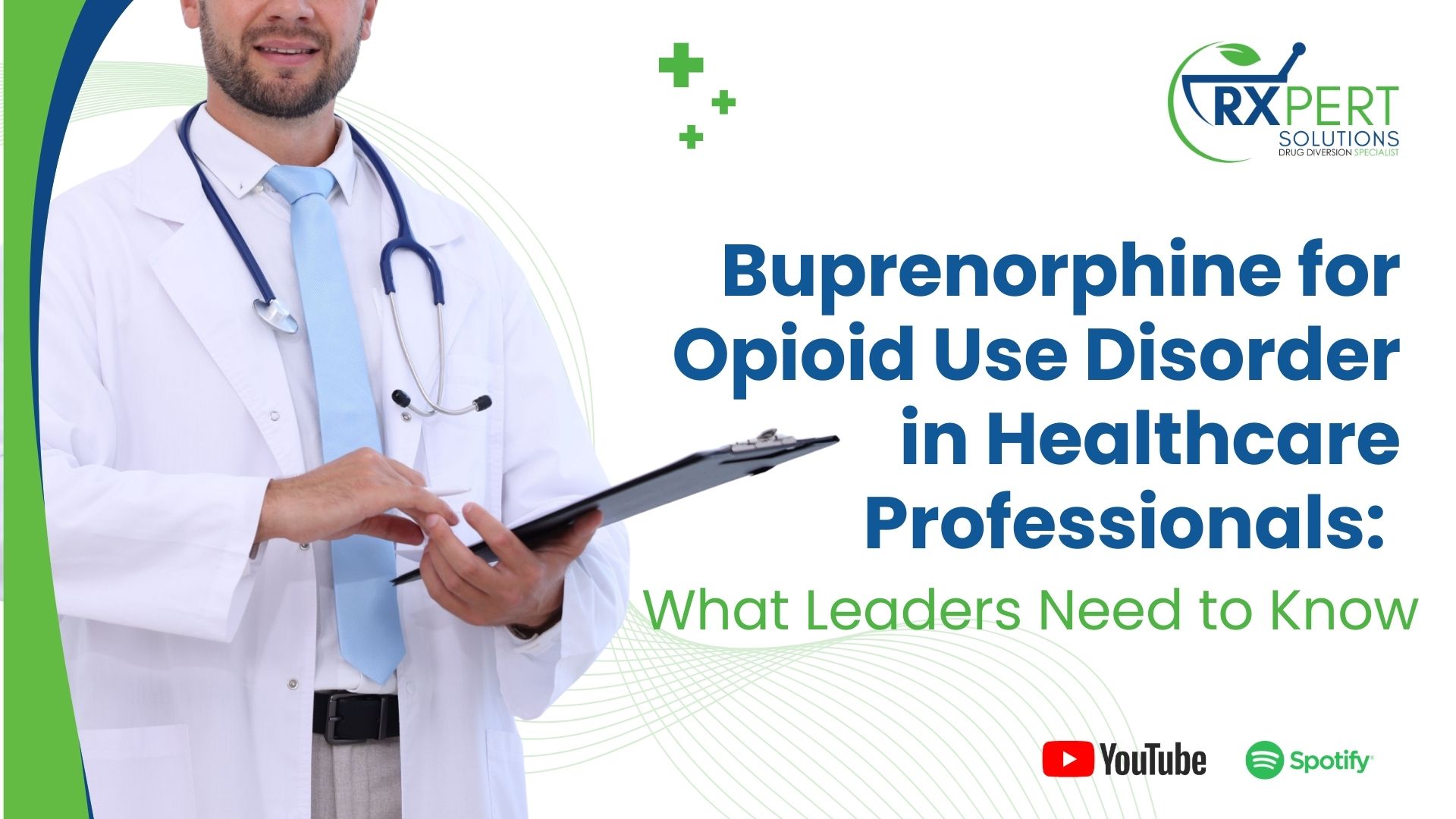
Buprenorphine for opioid use disorder in healthcare professionals is one of the most debated and misunderstood topics in addiction medicine today. In a recent episode of the Diversion Insights podcast.

Addiction psychiatrist Dr. Stuart Gitlo explored the controversy surrounding buprenorphine (Suboxone), especially concerns from patients who felt unprepared for long-term treatment or the difficulty of stopping. As more healthcare organizations encounter clinicians in recovery, understanding buprenorphine for opioid use disorder in healthcare professionals is no longer optional — it is a leadership responsibility.
“People have to realize that addictive disease isn’t about the drug. It’s about the discomfort that folks feel with the illness when they are not using.”
— Dr. Stuart Gitlo, Diversion Insights Podcast
That statement reframes the entire conversation. Healthcare leaders are not just managing medications. They are managing risk, safety, recovery, policy, and public trust — all at the same time.
→ Request a Free 30-Minute Diversion Risk Assessment
Confidential. Strategic. Built specifically for healthcare organizations.
Buprenorphine for Opioid Use Disorder in Healthcare Professionals: Why It’s So Misunderstood
The controversy around buprenorphine often centers on a single question:
“Aren’t we just replacing one drug with another?”
Clinically speaking, yes — but that’s precisely the point.
Opioid use disorder (OUD) is widely recognized as a chronic medical condition. Like hypertension or diabetes, it requires stabilization before long-term improvement can occur. The American Society of Addiction Medicine (ASAM) recognizes buprenorphine as an evidence-based treatment for opioid use disorder in its National Practice Guideline.
The misunderstanding happens when treatment is confused with intoxication.
A healthcare professional on a stable, prescribed dose of buprenorphine is not “high.” They are stabilized. The difference matters — especially in safety-sensitive environments.
How Buprenorphine (Suboxone) Actually Works
Buprenorphine is a partial opioid agonist, meaning it activates opioid receptors — but to a limited degree.
According to the FDA-approved prescribing information, Suboxone contains:
- Buprenorphine (partial opioid agonist)
- Naloxone (opioid antagonist)
It is indicated for opioid dependence as part of a comprehensive treatment plan.
The “Ceiling Effect”
Unlike full opioid agonists such as oxycodone or heroin, buprenorphine has a ceiling effect on respiratory depression. That means increasing the dose does not proportionally increase breathing suppression.
Peer-reviewed literature supports this pharmacologic property while emphasizing that risk still exists when combined with sedatives or alcohol.
For healthcare employers, this distinction is critical:
- Illicit opioid use = unpredictable overdose risk
- Stable buprenorphine treatment = controlled, monitored risk
That does not eliminate diversion risk — but it fundamentally changes the clinical risk profile.
The Role of Naloxone in Suboxone
Naloxone is included in combination products primarily as a misuse deterrent. If injected, naloxone can precipitate withdrawal. When taken sublingually as prescribed, buprenorphine is the dominant active component.
This design supports safety while discouraging injection misuse — an important feature in controlled environments.
Why Patients Say It’s Hard to Stop
One of the most consistent patient complaints is:
“I wish someone had told me how hard it would be to stop.”
There are three reasons for this.
1. Tapering Must Be Slow
Discontinuation is not a 30-day process.
Clinically comfortable tapers often require:
- 6 months minimum
- Frequently 12 months
- Sometimes longer
The final 1–2 milligrams are typically the most difficult.
Abrupt cessation leads to predictable withdrawal discomfort.
2. Baseline Symptoms Return
As discussed in the podcast, what patients describe as “post-acute withdrawal” often includes the re-emergence of:
- Anxiety
- Depression
- Sleep disturbance
- Irritability
- Stress intolerance
These symptoms may not be withdrawal at all. They may reflect the underlying discomfort that contributed to opioid use in the first place.
This is a crucial leadership insight:
Stopping medication does not cure the disease.
3. Life Instability Magnifies Symptoms
By the time someone reaches treatment, their life is often destabilized:
- Financial strain
- Relationship breakdown
- Licensing consequences
- Workplace monitoring
- Legal exposure
Tapering during instability dramatically increases relapse risk.
For healthcare organizations, encouraging abrupt abstinence without structural support may increase risk rather than reduce it.
Are Healthcare Professionals Impaired on Buprenorphine?
This is where policy must be grounded in science.
A clinician on a stable dose of buprenorphine:
- Is not intoxicated
- Is not sedated
- Is not cognitively impaired solely due to appropriate treatment
However:
- Fitness-for-duty decisions must be individualized
- Role-specific risk matters
- State boards and regulatory frameworks vary
Leaders must separate:
- Medication-assisted treatment
- Active diversion behavior
- Acute impairment
These are not the same.
Medication Is Only One Part of Treatment
SAMHSA’s TIP 63 emphasizes that medication for opioid use disorder (MOUD) should be paired with psychosocial support and structured recovery planning.
That means:
- Counseling
- Behavioral therapy
- Monitoring
- Long-term support
Medication alone is stabilization — not complete recovery.
For healthcare employers, that underscores the need for:
- Clear return-to-work policies
- Structured monitoring frameworks
- Defined documentation pathways
- Transparent escalation procedures
What This Means for Healthcare Organizations
Healthcare leaders face dual responsibility:
- Protect patients
- Support safe recovery
These objectives are not mutually exclusive — but they require design.
Best Practices Include:
- Develop a written MAT-aware policy
- Define fitness-for-duty evaluation triggers
- Align occupational health with addiction specialists
- Monitor controlled substance access patterns
- Separate fact-finding from punitive reaction
→ Get a Drug Diversion Quote
Understand your organization’s exposure points.
The Real Institutional Risk
The greatest liability is rarely the medication itself.
It is:
- Undetected diversion
- Inconsistent policy enforcement
- Stigma-driven concealment
- Abrupt employment termination without treatment pathways
- Poor documentation
A clinician stabilized on buprenorphine within a structured program may represent far less risk than one forced into secrecy or untreated relapse.
Leadership clarity reduces chaos.
Final Takeaways for Healthcare Leaders
- Buprenorphine is an evidence-based treatment for opioid use disorder.
- It has pharmacologic safeguards that reduce overdose risk compared to full opioid agonists.
- Most patients require long-term maintenance.
- Discontinuation is slow and must be clinically supervised.
- Recovery support and diversion prevention must operate together.
Healthcare organizations that ignore medication-assisted treatment policy create greater exposure than those that address it proactively.
→ Talk to a Diversion Specialist Today
Confidential. Practical. Healthcare-specific.