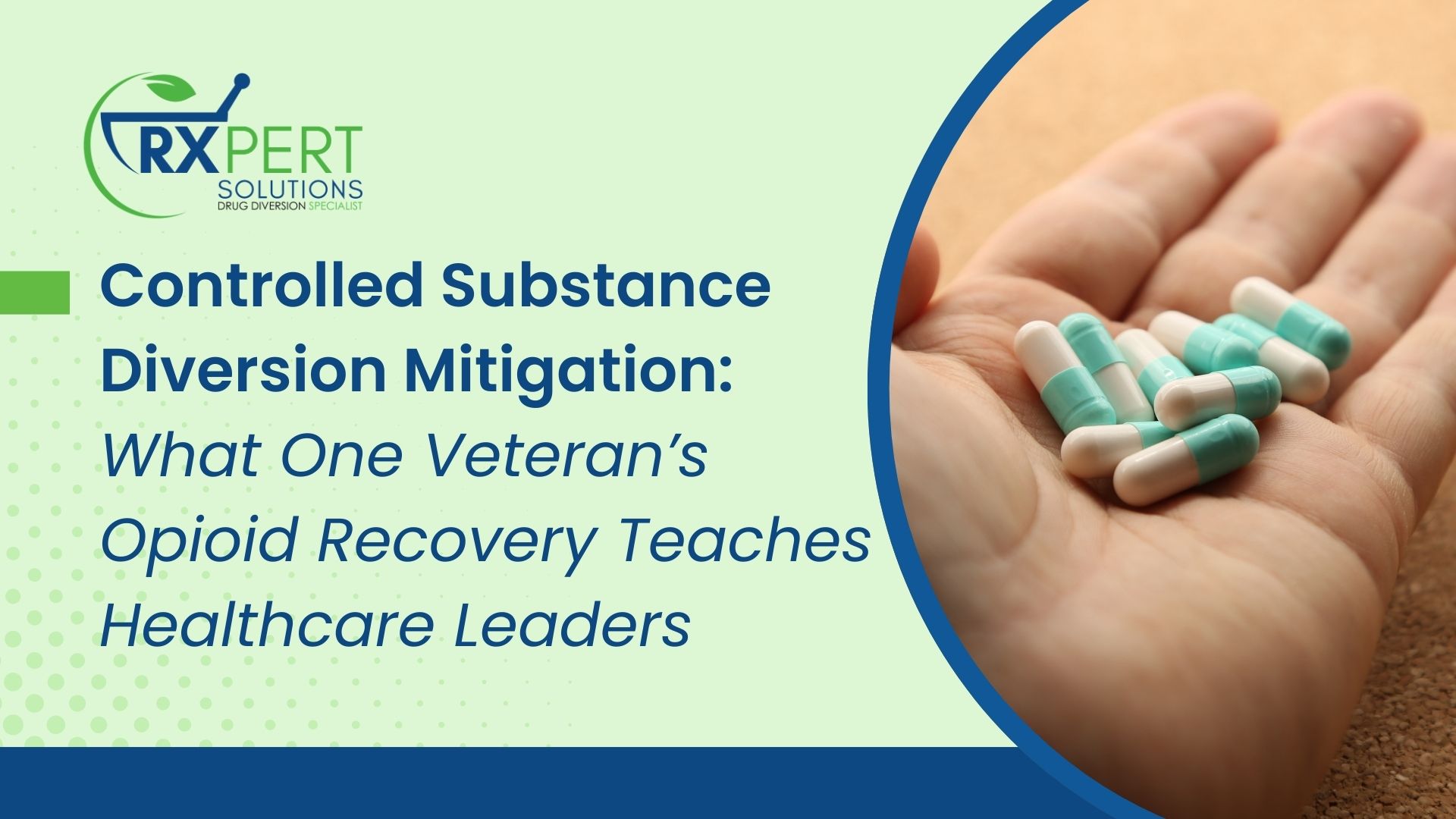
Controlled substance diversion mitigation isn’t just about audits, surveillance systems, or DEA compliance checklists. It requires understanding how opioid dependency can develop — even in disciplined, high-performing professionals.
Major Glenn Ignacio was a 22-year Air Force Special Operations and Combat Rescue Pilot. A senior officer. A master’s-degree-educated executive. A mission-driven leader.

He had never used illicit drugs. Never misused medication.
Yet after receiving a medically necessary prescription for severe hip damage, he eventually found himself taking 240 mg of oxycodone daily — enduring acute withdrawal, navigating Post-Acute Withdrawal Syndrome (PAWS), and spending years in structured recovery.
His story is not about criminal intent.
It is about how physiological dependence develops — and why healthcare organizations must approach controlled substance diversion mitigation with vigilance, structure, and informed oversight.
If your hospital, pharmacy, or health system handles controlled substances, you need visibility into diversion risk before regulators do.
→ Request a Free 30-Minute Risk Assessment
Confidential. No obligation. Immediate clarity.
How Legitimate Pain Management Can Evolve Into Physical Dependence
Glenn’s journey began with decompression injury damage — commonly known as “the bends” — which destroyed cartilage in his hip.
The pain was severe.
He was prescribed Percocet:
- 5 mg
- Then 10 mg
- Then 15 mg
After surgical complications and worsening structural damage, the dose escalated. Eventually, he was taking 240 mg of oxycodone daily.
This progression did not happen recklessly. It occurred gradually, under medical supervision, across nearly two years.
The CDC has documented that long-term opioid therapy — even when medically appropriate — can result in physical dependence and withdrawal symptoms when discontinued.
For healthcare leaders, this is a critical operational insight:
Dependence can develop in compliant, high-integrity individuals.
That reality has direct implications for controlled substance diversion mitigation within clinical environments.
The Relief That Reinforces Dependence
Glenn expected sedation.
Instead, he experienced:
- Mental clarity
- Focus
- Pain relief
- Improved work productivity
It was not about euphoria. It was about relief.
Relief reinforces behavior.
Reinforcement conditions neurological pathways.
This is how dependence develops quietly — without intent, misconduct, or policy violations.
Within healthcare settings, that neurological reinforcement can intersect with professional access to controlled substances — increasing organizational risk if monitoring systems are not structured for early detection.
Acute Withdrawal: The Physiological Shock
When Glenn decided to discontinue opioids, he experienced severe acute withdrawal:
- Vomiting
- Loss of bowel control
- Flu-like symptoms
- Restless leg syndrome
- Exhaustion
- PTSD symptom resurgence
Acute withdrawal lasted roughly two weeks.
However, the most destabilizing phase came afterward.
Post-Acute Withdrawal Syndrome (PAWS): The Extended Risk Window
Following detoxification, Glenn experienced recurring cycles every three to four weeks:
- Depression
- Fatigue
- Flu-like symptoms
- Pain-triggered cravings
- Psychological instability
This condition, known as Post-Acute Withdrawal Syndrome (PAWS), reflects ongoing neurological recalibration after opioid dependence.
The National Institute on Drug Abuse classifies addiction as a chronic brain condition involving altered brain circuitry — not a moral deficiency.
For Glenn, PAWS persisted for months.
This extended vulnerability window is particularly relevant in healthcare environments where professionals may retain access to controlled substances during recovery.
Without structured oversight, this period represents elevated diversion risk.
Why Healthcare Leaders Must Understand This Progression
Many organizations assume diversion begins with intentional misconduct.
But in clinical reality, diversion risk often evolves through a predictable progression:
- Legitimate prescription
- Tolerance development
- Dose escalation
- Physical dependence
- Withdrawal instability
- Workplace access to narcotics
- Rationalization under stress
- Diversion
Most impaired clinicians begin their careers as high performers.
Without structured mitigation systems, organizations may miss early warning indicators until diversion has already occurred.
What Happens When Systems Are Reactive Instead of Structured
During his VA recovery program, Glenn met a young Green Beret:
- Leg amputated due to IED blast
- Prescribed opioids
- Abruptly discontinued without taper
- Transitioned to heroin due to cost and accessibility
Abrupt discontinuation combined with lack of monitoring can accelerate destabilization.
Translate that scenario into a hospital environment without strong mitigation controls:
- Medication tampering
- Patient harm
- DEA scrutiny
- CMS investigations
- Civil liability
- Multi-million-dollar penalties
Controlled substance diversion mitigation is not theoretical. It is operational risk management.
The Neurology of Cravings in Healthcare Settings
One of Glenn’s most important recovery insights:
Cravings are neurological responses to conditioned triggers.
Whenever he experienced normal muscle soreness, his brain anticipated opioids.
In healthcare environments, risk amplifies when professionals:
- Have routine narcotic access
- Work high-stress shifts
- Experience chronic pain
- Fear professional consequences
- Conceal symptoms
This is why effective diversion mitigation extends beyond inventory reconciliation.
It requires behavioral monitoring, anomaly detection, and structured intervention pathways.
The Role of Medication-Assisted Treatment (MAT)
To stabilize recovery, Glenn was prescribed Suboxone (buprenorphine/naloxone), which:
- Stabilizes opioid receptors
- Reduces cravings
- Lowers misuse risk
He remained on treatment for several years before tapering successfully.
Today, he manages chronic pain through alternative therapies and structured discipline.
He had support systems.
Many healthcare professionals do not.
Which is why organizational mitigation infrastructure matters.
What Effective Controlled Substance Diversion Mitigation Requires
Diversion mitigation is not achieved by counting narcotics alone.
It requires a comprehensive compliance framework:
1. Advanced Monitoring Systems
- Automated analytics
- Peer comparison modeling
- Pattern recognition
- Real-time alerts
2. Behavioral Risk Signal Identification
- Documentation inconsistencies
- Override frequency anomalies
- Waste discrepancies
- Shift-based variance analysis
3. Structured Reporting Culture
When staff fear immediate termination, issues are concealed.
Structured reporting pathways reduce catastrophic diversion events.
4. Intervention & Monitoring Pathways
- EAP coordination
- Monitoring agreements
- Reintegration protocols
- Confidential peer oversight
5. DEA-Ready Compliance Infrastructure
Proactive compliance strengthens regulatory defensibility and reduces investigation exposure.
This is where many healthcare systems struggle.
Get a Drug Diversion Risk Assessment Before Regulators Do
Rxpert Solutions specializes in:
- Controlled substance diversion mitigation frameworks
- DEA compliance readiness
- Policy and gap audits
- Data analytics optimization
- Staff education on risk indicators
- Compliance strengthening strategy
If you do not know your organization’s diversion vulnerabilities, regulators eventually will.
→ Get a Drug Diversion Quote Today
Practical. Confidential. Actionable.
Reducing Stigma Strengthens Early Detection
One of the most destabilizing parts of Glenn’s experience was being misunderstood during recovery.
In healthcare environments, stigma can drive:
- Concealment
- Delayed reporting
- Escalated diversion risk
- Increased regulatory exposure
When leadership models inform understanding of substance dependency, early disclosure becomes more likely.
Early disclosure supports mitigation.
Mitigation reduces organizational risk.
The “Small Wins” Leadership Model
During recovery, Glenn focused on incremental victories:
- Getting out of bed
- Preparing breakfast
- Walking with a cane
- Returning to structured exercise
Diversion mitigation operates the same way.
Not overnight transformation.
But incremental compliance strengthening:
- One monitoring enhancement
- One policy refinement
- One analytics upgrade
- One leadership training session
Small operational improvements prevent large regulatory crises.
Final Takeaway for Healthcare Leaders
Controlled substance diversion mitigation is not about assuming misconduct.
It is about:
- Understanding how dependency develops
- Recognizing early neurological risk signals
- Strengthening detection systems
- Building structured oversight
- Supporting safe intervention pathways
- Protecting patients and professionals
Glenn’s story demonstrates that opioid dependence can affect elite, disciplined professionals.
Mitigation must be proactive, structured, and operationally embedded.
Protect Your Organization Before a Crisis Forces Action
If your hospital, health system, or pharmacy handles controlled substances, now is the time to evaluate risk exposure.
→ Request Your Free 30-Minute Risk Assessment
No obligation. No pressure. Just clarity.
Because controlled substance diversion mitigation is not optional.
It is compliance strengthening.
It is enterprise risk reduction.
And it begins before the first red flag appears.