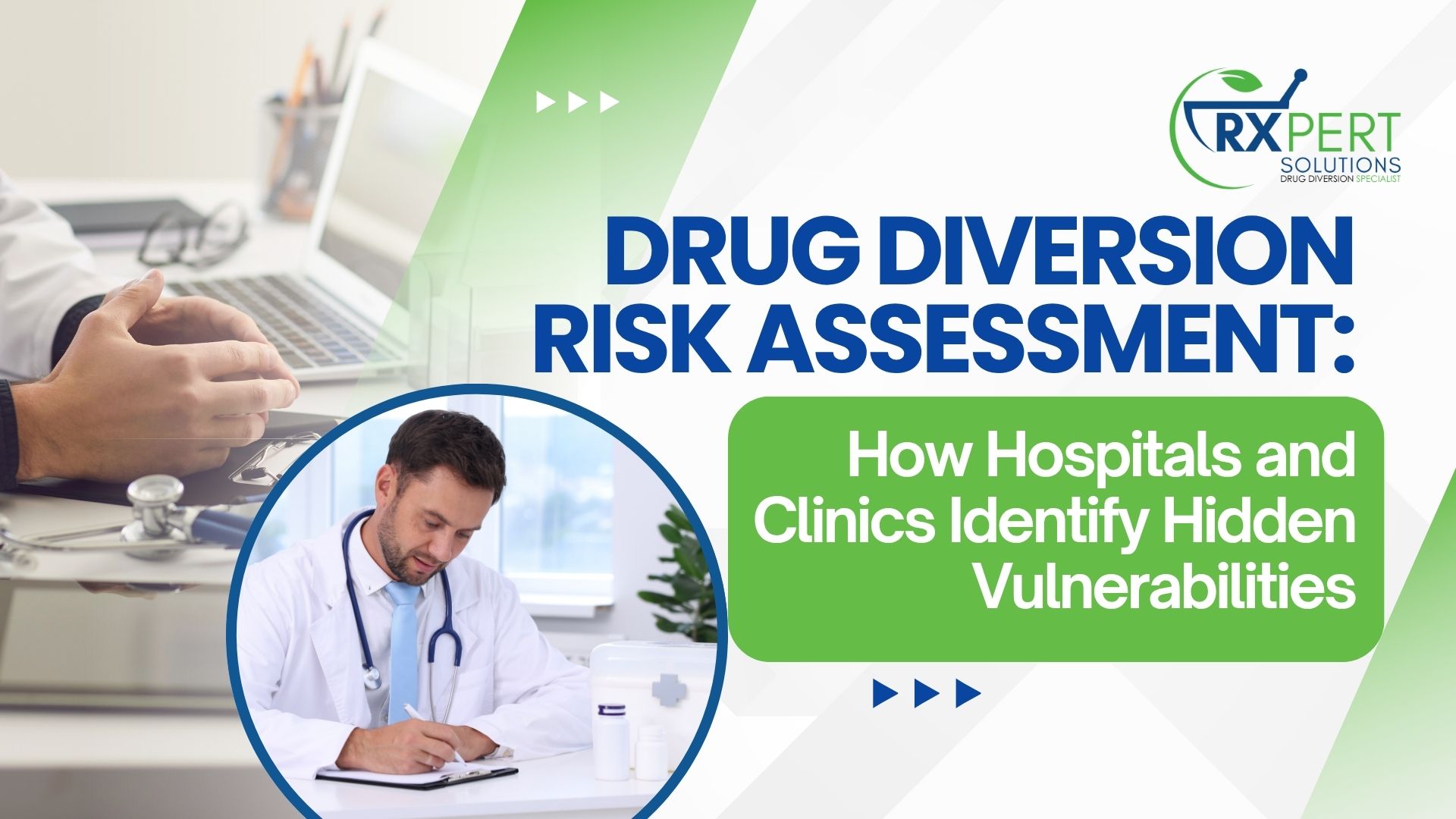
A drug diversion risk assessment helps hospitals and clinics identify where controlled substances are vulnerable to misuse, tampering, theft, documentation breakdowns, and other failures inside day-to-day workflows. This matters because diversion risk can affect patient care, staff wellbeing, regulatory exposure, and organizational trust. ASHP’s guidance notes that controlled substance diversion can lead to inadequate pain relief, inaccurate documentation, harm to the workforce, and liability for the organization.
Start with a clear diversion risk picture.
If your organization hasn’t conducted a recent diversion risk review, now is the time.
→ Request a Free 30-Minute Drug Diversion Risk Assessment
What Is a Drug Diversion Risk Assessment?
A drug diversion risk assessment is a structured review of how controlled substances move through your organization, where the highest-risk gaps exist, and whether current controls are working in practice, not just on paper.
In healthcare settings, this kind of review should go beyond a simple checklist. It should examine policies, access controls, purchasing and storage practices, dispensing patterns, administration workflows, wasting procedures, discrepancy resolution, reporting pathways, and investigation readiness. ASHP recommends that healthcare organizations evaluate employees, systems, and patient care environments for opportunities to strengthen controlled substance oversight across the full medication-use process.
That distinction is important. A narrow audit may confirm that certain steps are documented. A true drug diversion risk assessment asks whether those steps are reliable enough to support a strong diversion mitigation program in the real world.
Why Drug Diversion Is a Serious Risk for Hospitals and Clinics
Drug diversion is often discussed as a compliance problem, but the risk is much broader than that.
When controlled substance monitoring is weak, organizations may face patient harm, staff impairment, medication security failures, incomplete documentation, delayed investigations, and reputational damage. DEA states that its Diversion Control Division is responsible for detecting and investigating diversion from legitimate sources, underscoring how seriously controlled substance oversight is treated at the federal level.
For hospitals and clinics, the risk usually shows up in four areas.
1. Patient safety risk
If medication is diverted, a patient may receive less than ordered, experience delayed relief, or be exposed to tampering-related harm. ASHP identifies patient harm as one of the central consequences of diversion in health systems.
2. Staff and workforce risk
Diversion can also reflect impairment or substance use disorder in a healthcare worker. That creates risk not only for the individual involved, but also for coworkers, supervisors, and patients who depend on safe clinical judgment. ASHP specifically highlights staff education on signs and symptoms of impaired healthcare workers as part of a strong oversight framework.
3. Compliance and legal risk
Controlled substance failures can lead to reporting obligations, internal investigations, disciplinary action, and external scrutiny. CMS guidance emphasizes that suspected diversion must be taken seriously and documented carefully, while DEA oversight reinforces the need for prompt, defensible response.
4. Operational and reputational risk
Diversion incidents often expose weaknesses that leadership did not realize were present. Once a concern escalates, organizations may need to explain why warning signs were missed, why data was not reconciled, or why processes were not strong enough to support timely intervention.
Where Diversion Risks Commonly Appear
One reason a drug diversion risk assessment is so valuable is that diversion risk rarely sits in just one department.
CMS explains that diversion can occur through a variety of channels, and ASHP’s guidance frames the issue across procurement, storage, prescribing, preparation, dispensing, administration, and disposal.
In practical terms, high-risk areas often include:
- automated dispensing cabinet access
- override activity
- anesthesia workflows
- medication returns
- witness waste processes
- discrepancy resolution
- off-hours access
- handoffs between pharmacy, nursing, and procedural teams
- mismatches between documentation systems
A strong drug diversion risk assessment treats these as connected risks. If one part of the process breaks, the weakness often spreads into several others.
What Are the General Signs of Drug Diversion?
Many healthcare leaders know diversion is possible, but they are less certain about what the warning signs actually look like.
The truth is that signs of diversion are often hidden in patterns rather than single events. ASHP stresses the importance of rigorous monitoring, surveillance, education, and awareness of impaired healthcare worker indicators.
Common signs may include the following.
Documentation-related signs
- repeated discrepancies between dispensing, administration, and waste records
- late charting or unusual corrections
- missing witness documentation
- canceled transactions without clear explanation
- incomplete reconciliation between systems
Access-pattern signs
- unusually frequent overrides
- off-shift or off-hours controlled substance access
- pull patterns that differ sharply from peers
- repeated access to high-risk medications without obvious clinical need
Waste-related signs
- excessive waste volumes
- repeated wasting with the same witness
- waste documentation that clusters in unusual time windows
- inconsistencies between what was removed and what was charted as administered
Behavioral signs
- defensiveness when medication handling is questioned
- unusual interest in high-access assignments
- reluctance to participate in count or documentation review
- declining reliability or professionalism
Patient-care signs
- reports of inadequate pain control despite documented administration
- unexplained replacement doses
- unusual sedation or analgesia outcomes
- tampering concerns tied to medication handling
No single sign proves diversion. That is why a drug diversion risk assessment should combine data review, policy review, workflow observation, and follow-up analysis.
Many hospitals don’t discover diversion risks until after an incident.
A structured evaluation of medication workflows can reveal vulnerabilities early.
→ Explore RXpert’s On-Site Drug Diversion Risk Assessment
What a Strong Drug Diversion Risk Assessment Should Review
Not every review deserves to be called a full drug diversion risk assessment. A meaningful assessment should evaluate both written controls and actual practice.
Governance and accountability
Who owns diversion oversight? Is there an interdisciplinary structure that includes pharmacy, nursing, compliance, security, and leadership? Are responsibilities clear when concerns arise?
ASHP recommends defined accountability, reporting expectations, and response processes as part of a comprehensive controlled substance oversight approach.
Access and security controls
Who can access controlled substances, and how often is that access reviewed? Are privileges role-based and updated promptly when staffing changes occur? Are storage and distribution points evaluated routinely?
Workflow reliability
Do staff follow the written process consistently? Are witness waste procedures dependable? Are discrepancies investigated the same way across departments? Are handoffs creating blind spots?
Data integrity and surveillance
Does the organization compare ADC, EMR, dispensing, and waste documentation in a meaningful way? Are exception reports actually reviewed by people who understand diversion patterns? Are leaders confident in the quality of the data they rely on?
Investigation readiness
When a concern is flagged, what happens next? Who reviews it? How fast does the team respond? Is there a documented process to preserve information, escalate concerns, and move from suspicion to defensible findings?
Staff education and reporting culture
Do managers and frontline staff know how to recognize warning signs? Do they understand how to report concerns? Is the culture supportive enough that issues are raised early instead of ignored?
These are the areas where a drug diversion risk assessment often creates the most value, because they reveal whether a mitigation strategy is actually functional.
Best Tools for Drug Diversion Risk Assessment Healthcare Teams Can Use
When people search for the best tools for drug diversion risk assessment healthcare teams use, they often expect a software list. In reality, the strongest programs use multiple tools together.
Structured assessment frameworks
ASHP offers the Controlled Substances Diversion Prevention Program Assessment Tool, which helps organizations compare their current state against best-practice recommendations and identify gaps for action planning. RXpert Solutions can refer to this by its official published name, while still framing the work internally as diversion mitigation.
Exception reporting and audit logs
Routine audits remain important. CMS states that routine auditing helps verify that quantities received correspond with quantities dispensed, which makes audit capability a core piece of a mature review process.
Cross-system analytics
The most useful analytics compare activity across multiple systems rather than relying on one report alone. Pulls, administrations, waste entries, overrides, returns, and discrepancies all need context.
Diversion monitoring software
Software can help detect unusual patterns faster, but software by itself is not a complete drug diversion risk assessment. Tools are only as strong as the workflows, reviewers, and follow-up processes behind them.
Independent operational review
An outside reviewer can observe actual practice, interview stakeholders, trace workflows, and identify normalized risk that internal teams may overlook. Joint Commission advisory materials describe controlled substance security and diversion mitigation assessment as part of broader medication management and safety consulting.
The best answer to this search question is simple: the strongest approach combines a structured framework, reliable data, workflow observation, and expert interpretation.
Which Professional Services Offer Specialized Drug Diversion Risk Assessment Audits for Hospitals and Clinics?
Hospitals and clinics generally have three options when they look for outside help.
1. Independent healthcare diversion specialists
This is the most targeted option. These providers focus specifically on controlled substance risk, diversion mitigation, monitoring practices, investigations, education, and program development.
2. Broader medication management advisory groups
Some consulting organizations include controlled substance security and diversion mitigation within wider medication safety engagements. Joint Commission’s advisory materials are one example of this broader category.
3. Monitoring and program development partners
Some organizations need more than an initial review. They need ongoing support to improve workflows, strengthen surveillance, refine policies, coach leadership, and sustain mitigation efforts after the assessment is complete.
For most hospitals and clinics, the most relevant answer is this: specialized drug diversion risk assessment audits are typically offered by independent healthcare diversion specialists, while broader medication management advisors may address related controlled substance security issues as part of wider consulting work.
Every healthcare organization needs a clear diversion mitigation strategy.
Independent evaluations can identify monitoring gaps before they become compliance issues.
→ Speak With a Diversion Mitigation Specialist
How to Choose the Right Partner
Not every vendor evaluates the same things. Before choosing a partner for a drug diversion risk assessment, look for the following.
Healthcare-specific experience
The partner should understand pharmacy, nursing, anesthesia, compliance, and investigation workflows in real healthcare environments.
Operational review, not just document review
A useful assessment should test how work is actually performed, not just whether policies exist.
Fluency in both tools and process
The right partner should understand software, analytics, and exception reporting, but also know that most failures involve process design, accountability, and follow-through.
Actionable findings
A strong assessment should produce prioritized recommendations, not just observations.
Ability to support mitigation after the review
Hospitals often need help with next steps, including monitoring design, policy refinement, education, investigation readiness, and leadership alignment.
Controlled substance oversight requires coordination between pharmacy, nursing, and compliance teams.
Independent monitoring can strengthen that process.
→ Explore Diversion Monitoring Services
When Should a Hospital or Clinic Schedule a Drug Diversion Risk Assessment?
The best time is before an event forces the issue.
A drug diversion risk assessment makes particular sense when:
- there has been a recent incident or near miss
- leadership suspects gaps but lacks a clear picture
- software is in place but confidence in the output is low
- audits are being done, but follow-up is inconsistent
- there has been turnover in pharmacy, compliance, or nursing leadership
- accreditation or regulatory scrutiny is approaching
- the organization wants a stronger diversion mitigation strategy before risk escalates
This is where independent review becomes especially valuable. It helps leadership move from assumptions to evidence.
Final Takeaway
A drug diversion risk assessment gives hospitals and clinics a structured way to identify hidden vulnerabilities before they grow into patient safety events, workforce crises, or regulatory problems.
The goal is not more paperwork. The goal is clearer visibility, stronger accountability, and a more reliable diversion mitigation program.
Authoritative guidance from ASHP, CMS, DEA, and Joint Commission all points to the same conclusion: diversion risk can emerge across the medication-use process, strong oversight requires active monitoring and evaluation, and organizations benefit from structured assessment rather than informal assumptions.
Drug diversion mitigation is an ongoing process.
A formal risk assessment can help your team identify gaps and prioritize action.
→ Request Your 30 min Free Risk Assessment