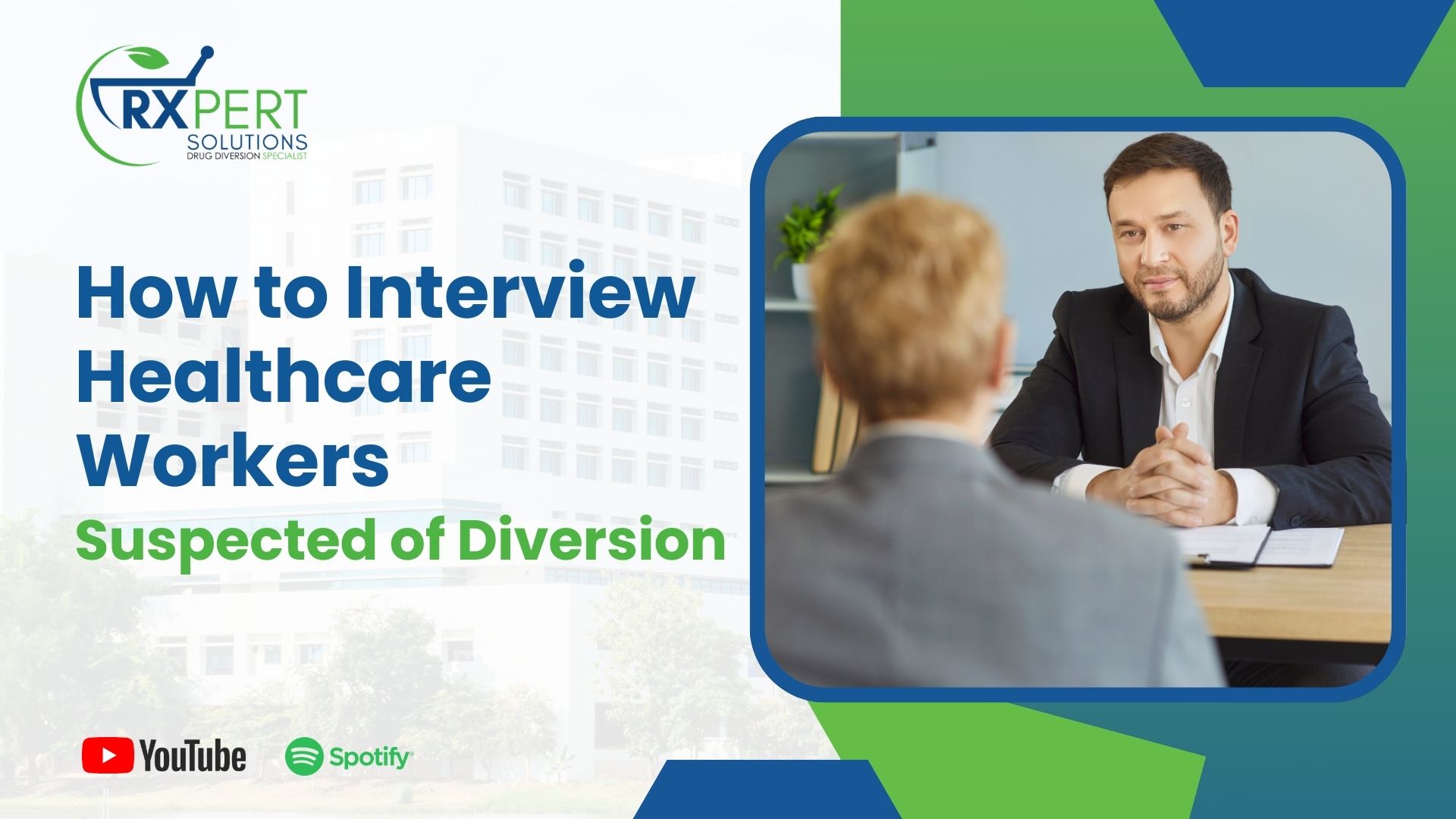
Interviewing healthcare workers suspected of diversion is one of the highest-stakes moments in any investigation. In this episode of Diversion Insights, Terri Vidals sits down with Dave Thompson, President of Wicklander, Zulawski & Associates, to discuss one of the hardest parts of a drug diversion investigation: interviewing a healthcare professional when diversion may be involved. The episode, titled “When Careers Hang in the Balance: Interviewing Healthcare Professionals Suspected of Diversion,” is available on both YouTube and Spotify.

Rather than treating the conversation like a routine HR step, healthcare organizations should approach it as a structured fact-finding process tied to patient safety, compliance, and long-term diversion mitigation. CDC notes that diversion by healthcare personnel can create direct patient safety risk and may require patient harm assessment and reporting steps in some situations.
Start with a clear diversion risk picture.
If your organization hasn’t conducted a recent diversion risk review, now is the time.
→ Request a Free 30-Minute Drug Diversion Risk Assessment
Why the interview matters
Audit data can tell you that something is off. It can show unusual waste, outlier removals, inconsistent documentation, or controlled substance activity that does not match peers. What it usually cannot do on its own is explain why that pattern exists.
That is why the interview matters so much in a healthcare diversion investigation. The conversation helps clarify whether the organization is looking at practice variation, workflow failure, intentional misconduct, possible self-use, or a broader systems issue. RXPERT’s own investigation resources reinforce that interviews are a core part of moving from suspicious data to reliable facts, not just a box to check after an audit review.
Terri captures that well in the episode when she says:
“The data is just telling you that something is off.”
That is the right starting point. The data raises the question. The interview helps answer it.
Start with the goal of the interview
One of the most useful insights from the podcast is that not every case should be handled the same way.
A suspected resale case is different from a suspected self-use case. A meeting designed to clarify documentation questions is different from one intended to determine scope, identify patient safety impact, or uncover control failures.
Dave Thompson says it plainly:
“Not every interview is the same and not every interview should be approached with the same exact steps in the conversation.”
That principle matters because interview strategy should follow purpose. Before anyone brings the employee into a room, the organization should know what it is trying to learn. Is the main question whether the audit pattern has an innocent explanation? Is the concern immediate impairment? Is the organization trying to understand whether the issue extends beyond one person or one shift? Is the bigger need to identify mitigation gaps?
Those are not small differences. They shape tone, sequencing, who should be present, and what kind of follow-up is needed.
If your team is unsure how to structure high-stakes diversion interviews, outside coaching can improve consistency and confidence.
→ Strengthen Your Approach with RXpert’s Interview Coaching for Drug Diversion Investigations
Behavior alone is not proof of deception
A common mistake in a drug diversion interview is assuming that visible stress means dishonesty.
An employee who avoids eye contact, becomes defensive, fidgets, shuts down, or appears unusually nervous may be hiding something. But they may also be overwhelmed, embarrassed, fearful, exhausted, or reacting to the pressure of the setting. If trauma history, substance use disorder, or possible impairment may be part of the picture, those behaviors become even harder to interpret cleanly. SAMHSA’s trauma-informed care guidance emphasizes that trauma can affect communication, perception, and behavior in ways that are easy to misread during stressful interactions.
That is why Dave’s warning is so important:
“We got to be careful classifying people as deceptive based off physical behavior.”
For healthcare leaders, the practical lesson is simple: body language may raise questions, but it should not decide the outcome. The goal of the interview is to gather reliable information, not to rely on shortcuts that feel persuasive in the moment.
This point is also supported by rapport-based investigative interviewing research summarized by the National Policing Institute, which emphasizes open-ended questions, active listening, patience, empathy, and information-gathering over premature judgment.
Rapport is not small talk
A lot of people hear “build rapport” and assume they need to make the interview feel casual. That usually is not what the situation requires.
In a healthcare diversion interview, rapport is better understood as transparency, steadiness, respect, and emotional control. It means the employee understands who is in the room, why the conversation is happening, and what the next part of the process will look like. It means the interviewer is calm enough to gather facts without escalating avoidable fear.
That approach lines up with evidence-based interviewing principles. Research summarized by the National Policing Institute describes rapport-building as a practical tool for disclosure and cooperation, supported by active listening, respect, affirmations, open-ended prompts, autonomy, and empathy without condoning misconduct.
Dave puts it well:
“Rapport is more than what people classify it as.”
For healthcare organizations, that matters because the interview is not just about asking better questions. It is about creating conditions where better answers are more likely.
The right interview outcome often depends on what happens before the first question is asked.
→ Learn How to Set the Stage for a More Effective Diversion Interview
High-stakes interviews require more than instinct. Teams need a repeatable strategy they can use with confidence.
→ Explore RXpert’s Diversion Interview Strategy and Techniques Training
A stronger way to open the conversation
The opening matters more than many teams realize.
If the employee is brought into a room and immediately hears loaded terms like “fraud,” “theft,” or “diversion investigation,” the interview can become adversarial before it begins. The point is not to hide seriousness. The point is to avoid increasing defensiveness before the organization has gathered the employee’s account.
A stronger opening sounds more like this:
“Thanks for taking the time to meet with us. We want to better understand some questions about workflow and controlled substance documentation, and it’s important that we hear directly from you before making assumptions. We’ll start with some general questions and may get more specific as we go. [Name] is here to help with notes.”
This kind of language works because it is transparent without being needlessly confrontational. It explains why the person is there, what the conversation will look like, and who else is involved.
It also matches the real purpose of the conversation. The organization does not yet need a dramatic opening. It needs useful information.
Let the employee talk before you show everything
When audit findings look serious, many teams want to bring the full packet into the room and go line by line. That is understandable, but it is often not the strongest way to begin.
If you show all your evidence too early, you reveal the scope of what you know. You also turn the conversation into a reaction exercise, where the employee focuses on explaining away the specific items you presented instead of providing a fuller account in their own words.
A better strategy is to begin broadly:
- Walk me through a typical shift.
- How are wastes handled on your unit?
- What usually causes documentation delays?
- How were you trained on this process?
- What does a busy-day workaround typically look like?
This kind of approach is consistent with rapport-based interviewing principles that emphasize information-gathering rather than immediate confrontation.
It also matters in healthcare because the employee may know the system far better than the interviewer does. A nurse, pharmacist, or technician may understand loopholes, workflow exceptions, or unit-specific practices that a non-clinical interviewer would miss. That is one reason subject matter expertise can be valuable in preparation or as limited support during the conversation.
Empathy matters, but minimization is a mistake
Healthcare leaders often hear that they should use empathy when substance use disorder may be involved. That is true. But empathy is not the same thing as minimizing the conduct.
A good interview can acknowledge that the employee may be scared, ashamed, or struggling without suggesting that the issue is small or consequence-free. That balance is especially important in healthcare, where the conversation may involve both a possible health condition and a serious patient safety concern.
SAMHSA’s trauma-informed care framework supports approaches built around trust, safety, collaboration, and awareness of how trauma can affect behavior. At the same time, that framework does not eliminate the need for structure, accountability, or appropriate organizational response.
In practical terms, that means avoiding language that sounds like:
- “This isn’t a big deal.”
- “Just admit it and it will go easier.”
- “This happens all the time.”
Those phrases may sound reassuring, but they blur seriousness and can create more confusion later.
Every healthcare organization needs a clear diversion mitigation strategy.
Independent evaluations can identify monitoring gaps before they become compliance issues
→ Speak With an RXpert Diversion Mitigation Specialist
“Drug test me right now” does not prove innocence
One of the most practical parts of the podcast is the discussion around statements like, “I’m not doing anything wrong. You can drug test me right now.”
That kind of statement does not prove innocence. It may be truthful. It may be a bluff. It may reflect the employee’s assumption that testing is the only issue that matters. It may also be an attempt to redirect the conversation away from broader conduct or a larger pattern.
The better principle is not to decide what an innocent or guilty person “would say.” The better principle is to gather information, compare it with the evidence, and keep the organization’s true objective in view.
That matters because suspected diversion in healthcare is often bigger than a single moment or test result. CDC’s clinician guidance notes that suspected diversion can require patient harm assessment and public health response depending on the circumstances, especially where tampering or exposure risk may be involved.
Subject matter expertise matters
A healthcare diversion interview is not like many general workplace interviews because the person being interviewed may understand the operational environment in much greater detail than the interviewer.
A clinician may know medication workflows, dispensing exceptions, documentation patterns, and access points far better than HR, legal, or security staff. That does not mean non-clinical leaders cannot run strong interviews. It does mean preparation matters.
That is why some organizations benefit from preparing the interviewer with a subject matter expert or including one in the room in a limited, clearly defined role. The goal is not to overwhelm the employee. The goal is to ensure the interviewer can recognize what is plausible, what is evasive, and what deserves a deeper follow-up.
Strong interviews start with strong intelligence. Ongoing monitoring helps teams spot patterns earlier and walk into interviews better prepared.
→ See How RXpert’s Drug Diversion Monitoring as a Service Strengthens Investigations
Interview decisions are easier when your organization already has a clear mitigation framework in place.
This is not just an interview problem. It is a mitigation problem.
The strongest takeaway from this article is that the interview should not be treated as a one-off event after suspicious data appears.
It belongs inside a larger mitigation framework that includes:
- active monitoring
- clear policy
- investigation process
- training
- escalation pathways
- support resources where appropriate
CDC frames diversion by healthcare personnel as a patient safety issue, not just a workplace conduct problem. RXpert’s own service structure reflects the same reality: interview quality improves when the organization has a stronger overall mitigation program, not just a better script for one meeting.
That is why better interviews usually start long before the room is booked.
Diversion often hides in complex medication data.
Advanced analytics can identify patterns that manual audits miss.
→ Request a Free 30-Minute Drug Diversion Risk Assessment